Price:
This post was made using the Auto Blogging Software from WebMagnates.org This line will not appear when posts are made after activating the software to full version.
Price:
Price: $12.98
Price: $192.00
Price: $12.99
Price:
Price:
 Best Science Supplies, offering quality scientific equipment and supplies since 1988. If you buy multiple items, we will adjust the shipping and refund you the difference to reflect the actual shipping and handling costs. Our prime manufacturers are certified with ISO and CE, respectively, Norway's and The Netherland's Ministries of Health. These instruments are constructed of high grade surgical stainless steel. Should you be dissatisfied in any way with your purchase, please do not hesitate to contact us. We strive to assure your satisfaction.
Price:
This book provides a thorough presentation of instrument construction, from conception to development and pre-testing of items, formatting the instrument, administration, and, finally, data management and presentation of the findings. Throughout the book, the authors emphasize how to create an instrument that will produce trustworthy and accurate data. To that end they have included guidelines for reviewing and revising the questionnaire to enhance validity and reliability. They also show how to work effectively with stakeholders such as instruments designers, decision-makers, agency personnel, clients, and raters or respondents.
Price: $70.00
Price: $419.00
Price:
Price: $130.00
Price: $85.00
Price:
Price: $49.99
Price: $19.99
Price: $21.95
This book covers the essential information needed to understand the problems involved in translating existing questionnaires and other paper and pencil instruments from one language to another as well as to apply methods for dealing with them. It shows researchers how to identify the problems (comparison of parameters, nomological nets, and semantic problems) with an existing instrument; how to solve each of these problems with step-by-step guidelines; and techniques for reconstructing an instrument or designing an original one to use with different cultural groups. This book will provide researchers with a guide for construction of cross-national survey instruments.
Price: $19.95
Price:
Price:
Price: $21.95
Price: $139.00
Price:
Price: $21.95
Price: $149.00
Price:
Price:
Price:
Price: $149.00
Price:
Price:
Price: $9.95
Price: $650.00
Price:
Price: $179.99
Price: $17.95
Price: $175.00
Price: $13.99
Price:
Price: $19.99
Price: $149.00
Price: $24.95
Price: $149.99
Price: $21.95
Price:
Price: $25.00
Price: $19.99
Price: $149.00
Price: $15.23
Price:
Price:
OK, this is an ad. I can't vouch for it. I'm almost embarrassed to be showing it to you. But you have to take a look. When I saw it yesterday, I had to pick my jaw off the floor. This product, called "Ultra Ever Dry" is a nano-tech coating you can spray on any number of different surfaces, shoes, cinder blocks, coats. (Your hands? Probably not.) It's superhydrophobic (it repels water) and oleophobic (repels hydrocarbons) — but words don't do it justice.
What is it? The company says it's a "coating" that will repel almost any liquid by creating a barrier of air on the surface. They don't say what's in the coating. Whatever it is, the How to Apply This Product video suggests you don goggles, gloves and protective gear when you spray. They claim it will protect in temperatures ranging from -30 degrees Fahrenheit to 300 degrees Fahrenheit, but durability is a question. In the video, they say abrasion might affect performance (which makes me wonder how long a pair of sprayed boots would stay dry if you were on a wet, slippery, rocky hiking trail). It's expensive. The base coat is $57.95 and the top coat is $100.95 a quart. On the other hand, if you dare to spray it on your car windows, you wouldn't need window wipers. Or would the windows get too cloudy? If you sprayed it on a car surface, would it affect the gloss? Probably.
I have so many questions.
Trolling various Internet sites, I found crazier questions, some of them sci-fi delightful. A guy wondered what would happen if he coated his boat with this stuff. If water is no longer a drag on your forward motion, maybe his boat would shoot through the water like a rocket. He wanted to try it. But when he wrote the company, they warned that at fast speeds, with less drag, "overall stability" might be affected. Meaning he'd get dunked.
Which raises another question. What if you coated yourself with this stuff and dove into a pool? Surrounded now by a thin coat of air, would you sink? Struggle? Hmm, thought one commenter, "Probably you get ejected from the pool." Whooosh!
Nanotechnology is starting to get interesting.
I realize we don't have a lot of information about this product, not yet, and we may discover after a few months in general use, it turns out to be pretty basic water-resister, not unlike many products already on the market, in which case, my hat goes off to whoever wrote and shot that video. There's an art in getting people excited and curious. After all, consider the greatest ad ever, ("It picks up pinecones!") for a garden tool called the "Wonder Rake 5000":
View the original article here
Toyota and BMW have formed an alliance to work on fuel cell cars. So have Daimler, Ford, and Nissan, with hopes of having cars on the road by 2017. But why now, and what obstacles still stand in the way? Jennifer Kurtz discusses the current state of hydrogen fuel technology.
Copyright © 2013 NPR. For personal, noncommercial use only. See Terms of Use. For other uses, prior permission required.JOE PALCA, HOST:
This is SCIENCE FRIDAY. I'm Joe Palca, sitting in for Ira Flatow. This is SCIENCE FRIDAY. I'm Joe Palca, sitting in for Ira Flatow. Later in the hours, digital privacy and dating the demise of the dinosaur, that's a lot of D's. But first, last week, Daimler, Ford and Nisson announced an alliance to work together on hydrogen fuel-cell technology for their passenger vehicles. That follows on the heels of a similar announcement last month from Toyota and BMW. Other major automakers have signaled that they're fuel cell, too.
But where does the technology stand now, and what needs to be done to make the carmakers' hopes of getting tires on the road by 2017 a reality? What obstacles still stand in the way? That's what we're talking about first this hour. So give us a call. Our number is 1-800-989-8255, that's 1-800-989-TALK. If you're on Twitter, you can tweet us your questions by writing the @ sign followed by scifri. If you want more information about what we'll be talking about this hour, go to our website, www.sciencefriday.com, where you'll find links to our topic.
And now I'd like to introduce my guest. Jennifer Kurtz is a senior engineer and the leader of the Technology Validation Group in the NREL Fuel Cell and Hydrogen Technologies Program, part of the National Renewable Energy Laboratory in Colorado. Jennifer Kurtz, welcome to SCIENCE FRIDAY.
JENNIFER KURTZ: Thank you, Joe, and I'm happy to be on the program today.
PALCA: Oh, that's great. So you've - I mean, what have you been doing with these cars over at NREL? What's been the last few years? Have you been driving them? Have you driven them?
KURTZ: Yeah, in fact I was driving a fuel-cell vehicle this morning. We went out and got some bagels for our center to celebrate the interview today.
PALCA: So is it a different kind of experience? Do you feel like you're not driving - I mean, is it different from a normal car, You know, the cars we're used to, internal combustion?
KURTZ: Yeah, no, the car has some unique characteristics, one of them being zero tailpipe emissions. It's quite quiet. But, you know, once you start driving the vehicle, it's really easy to forget that you're driving fuel-cell vehicle. It's just like a standard, traditional driving experience.
And since we had visitors on site, we had five adults in the vehicle. It was very easy to carry a conversation. And it becomes just a standard mode of transportation.
PALCA: So do they look any different from other cars, or can you put a fuel-cell engine into any - or a fuel-cell-equipped engine into any kind of car?
KURTZ: You can use any car, actually. We have - the vehicles that we've analyzed, they range from compact sedans all the way up to SUVs.
PALCA: So what's the advantage, do you think, of using a hydrogen-powered, full-cell-driven, fuel-cell energy care over, say, you know, one that you just plug in?
KURTZ: Well, for the fuel-cell vehicle, the zero tailpipe emissions is one key aspects. These vehicles can be filled in three to five minutes, and right now there are hydrogen stations available 24/7 and have very traditional retail-style filling capabilities. Vehicles - excuse me.
PALCA: No, go ahead. I was just going to ask, you said that there are filling stations available, but that made me wonder, you know, if I'm driving across the country, could I make it? I didn't think there were so many of those.
KURTZ: No, not across the country. The hydrogen stations, as well as the vehicle deployments, are very targeted right now, and that - so that the investments are not spread too thin. So for instance California, Hawaii, the Northeast all have focused activities in fuel cell and hydrogen deployment.
So for instances there is a pipeline station in Southern California. You can drive up and fill up. It looks very similar to a traditional gasoline pump. And fill your vehicle quickly and drive off. And with the vehicles, we validated a 250-plus-mile range on the vehicles we've analyzed. We've also participated in an on-road driving evaluation in collaboration with Toyota and Savannah River National Laboratory.
The results of that evaluation was a possible 431-mile on-road range. So range is another key aspect of fuel-cell vehicles.
PALCA: Right, so is that - I mean, we talked at the beginning, I said at the beginning about the obstacles. Is getting that kind of hydrogen infrastructure or the fueling infrastructure in place something that's one of the roadblocks to getting these cars on the road more widely?
KURTZ: Yes, that is a challenge. And one of the ways that we're working on that challenge is through highly collaborative relationships between automakers, energy industries and government, and that's state and federal government. So these activities include working groups to identify how to make the investment in stations.
It's also looking at scenario analyses so that we can understand risks with station deployment and really look at market and regulations and policies to help make sure that we're putting early stations in or the next generation of stations in key areas.
PALCA: Well, let's take a call from one of our listeners. We've got quite a few. And let's go first to Molly(ph) in Hillsboro, California. Molly, welcome to SCIENCE FRIDAY.
MOLLY: Hi, thank you. I was wondering two things. First, I'm wondering about the safety in terms of accidents on the road, it being hydrogen and all, and the second thing is I was wondering if there are plans in place to keep the manufacture and such in America.
KURTZ: Yes, so with regard to safety, the vehicles that we've analyzed through the support of the Department of Energy Fuel Cell Technologies Office, has had a very strong safety record. Safety is a key aspect to the vehicle and station deployment. It includes things like hydrogen sensing, alarms, control strategies to make sure that if there is a situation that the systems are shut down appropriately and quickly and safely.
Traffic accidents are common. With hundreds of fuel-cell vehicles on the road, we've actually some fuel-cell vehicles that have been in non-related hydrogen accidents. All onboard safety mechanisms reacted appropriately, and we didn't see released hydrogen.
And just from my personal perspective, I feel completely safe driving a hydrogen fuel-cell vehicle around, having my family and the people that I love in those vehicles.
PALCA: And I don't suppose you really have that much to say, Jennifer Kurtz, about whether or not these cars are built in America.
KURTZ: Well, you know, it's - you know, it's certainly an international effort. We've got the - just the OEMs that you mentioned at the beginning of the program. They're - it's international. So we do have deployments in the United States, and you're exactly right. In terms of manufacturing, that's outside of my spectrum.
PALCA: Yeah, let's take another cal now and go to Matt(ph) in Rockford, Illinois. Matt, you're on SCIENCE FRIDAY.
MATT: Hey, hello there, how are you guys doing?
PALCA: Great.
KURTZ: Great.
MATT: I have a question for you in regards to electrolysis and type of a hybrid fuel-cell vehicle. I've created a little HHO system run my whatchamacallit, my lawn mower. It seems to work. I cut the consumption in pretty much half. I've seen people on the Internet do the same things for their trucks, except they just purely run off of electrolysis, the HHO systems. Would you guys ever consider doing something like that?
Because I know the hydrogen systems that you guys are talking about, the infrastructures, you know, implement the stuff would be, you know, amazing in the cost it would take for the taxpayer to put up with the bill.
KURTZ: Well, how about we have a - there are a number of ways to produce hydrogen. And we have four fuel-cell vehicles on loan at NREL's campus fom Toyota. Our hydrogen is actually produced through electrolysis that's powered by wind and solar.
So a colleague has stated our fuel-cell vehicles are driving around today based on hydrogen produced from wind that blew last week. So that's an example of an exciting way to produce hydrogen. There's also an example a trigeneration system right now in Southern California at a wastewater treatment facility.
This facility or this system uses biogas to fuel a fuel cell, and it co-produces heat, power and hydrogen for light-duty fuel-cell vehicles. So there are a wide range of possibilities and ways to produce hydrogen right now that are being worked on.
PALCA: So I've been wondering, you were talking earlier about the safety of these systems. I heard a very interesting lecture some weeks ago about these solid-state systems, some sort of a solid material that couldn't explode, that would be recharged, and you would sort of move it in and out, not really just a gas tank of hydrogen but something a little different. Do you know about those?
KURTZ: Well, my area of expertise is looking at and validating fuel-cell vehicles that are on the road today. Those fuel-cell vehicles are using compressed gasses, as you mentioned. Most of the vehicles are at 700 bar pressure. And so we've seen very strong safety records with those tanks. I think, as I mentioned, I feel comfortable with those fuel-cell systems and that onboard hydrogen storage system.
PALCA: So is there one thing at this point that you think is a barrier to getting these cars on the road? Is there something that - I mean, what would prevent it, for example, from making it by 2017?
KURTZ: Well, I think there are challenges that are being worked on. We talked about hydrogen infrastructure. I would say cost and durability are also two challenges remaining. I think what we've seen is a progression in terms of technology development.
For instance the vehicles that we looked at very early on, so this would be approximately 2003 technology, within the last decade, the range was - we've seen improvement in range, in freeze capability, in durability. And we've also - DOE has funded projects that have seen 80 percent cost reduction in fuel-cell systems.
We think with the partnerships, the investments that are being made by private industry, as well as government, will continue to see costs come down. But we certainly need to leverage economies of scale and investments across the board.
PALCA: Well, I'm wondering: What are costs? I mean, is this car going to be - are these first cars going to be comparable to what a standard car is going to cost, or are they going to be a lot more?
KURTZ: In terms of specific costs, I don't have the answer for you.
PALCA: Of course not.
KURTZ: But we have seen with all advanced vehicle technologies that there is a price premium associated with those technologies. So I expect that to be the case. But the partnerships, the recent announcements by the automakers have identified cost as a key area for development, whether they're looking to go in terms of the production scale.
For instance Hyundai has also announced recently they've kicked off their series production of up to 1,000 fuel-cell systems. So we should see in each phase of the deployment and wide-scale commercialization, or working towards wide-scale commercialization, that those costs won't come down.
PALCA: OK, well, we'll have to leave it there. We've run out of time. Jennifer Kurtz is a senior engineer and the leader of the Technology Validation Group in the NREL Fuel Cell and Hydrogen Technologies Program, part of the National Renewable Energy Laboratory in Colorado. Thanks for joining me today.
KURTZ: Well, thank you very much for having me on.
PALCA: And when we come back, digital privacy. Do you own any of your personal data? We'll be right back after this short break.
(SOUNDBITE OF MUSIC)
PALCA: This is SCIENCE FRIDAY from NPR.
(SOUNDBITE OF MUSIC)
PALCA: This is SCIENCE FRIDAY from NPR.
Copyright © 2013 NPR. All rights reserved. No quotes from the materials contained herein may be used in any media without attribution to NPR. This transcript is provided for personal, noncommercial use only, pursuant to our Terms of Use. Any other use requires NPR's prior permission. Visit our permissions page for further information.NPR transcripts are created on a rush deadline by a contractor for NPR, and accuracy and availability may vary. This text may not be in its final form and may be updated or revised in the future. Please be aware that the authoritative record of NPR's programming is the audio.View the original article here
Iranian President Mahmoud Ahmadinejad (center) visits a uranium enrichment facility in Natanz, Iran, in 2008. Enriching uranium requires many fast-spinning centrifuges, arranged in what's called a cascade.
Iranian President's Office/AP Iranian President Mahmoud Ahmadinejad (center) visits a uranium enrichment facility in Natanz, Iran, in 2008. Enriching uranium requires many fast-spinning centrifuges, arranged in what's called a cascade.Iran's government on Thursday made clear it has no interest in direct talks until the U.S. eases sanctions that have been squeezing Iran's economy. But the Obama administration isn't budging and says the ball is in the Iranians' court.
The suspicion that Iran wants to make a nuclear weapon is the rationale for the sanctions as well as for veiled threats of U.S. or Israeli military action if those sanctions fail.
Iran's perceived nuclear aspirations are also the subject of a global effort that keeps popping up in the news: the game of "nuclear keep-away" to keep Iran from buying or manufacturing centrifuges, the machines that make uranium suitable for a bomb.
"We call it the long pole in the tent," physicist David Albright, a former United Nations weapons inspector, tells All Things Considered host Robert Siegel. "Getting the wherewithal to make the weapon-grade uranium or the separated plutonium is harder than learning how and assembling everything you need to know to make the nuclear weapon itself."
Separate Your Isotopes
Most uranium is useless for nuclear fuel or weapons. Less than 1 percent of it is the light, radioactive isotope uranium-235 that's used for power plants and bombs.
This computer image from a NASA video shows the small asteroid 2012 DA14 on its path as it passes by Earth on Feb. 15.
NASAAn asteroid the size of an office building will zoom close by Earth next week, but it's not on a collision course, NASA says.
Still, some people think this near-miss should serve as a wake-up call.
"It's a warning shot across our bow that we are flying around the solar system in a shooting gallery," says Ed Lu, a former astronaut and head of the B612 Foundation, a nonprofit dedicated to protecting humanity from asteroids.
The asteroid known as 2012 DA14 was first spotted last year by astronomers in Spain. It's thought to be about 150 feet across and made of rock.
It will whiz past Earth on Feb. 15, going about 5 miles per second. At its closest approach, it will be only about 17,200 miles above the surface of our planet. That's far nearer to us than the moon, and even closer than some weather and communications satellites.
NASA officials say this event is one for the record books — the first time scientists have been able to predict something so big coming so close.
"There really hasn't been a close approach that we know about for an object of this size," says Donald Yeomans, manager of the Near Earth Object Program Office at NASA's Jet Propulsion Laboratory in Pasadena, Calif.
It will come closer than satellites in a geosynchronous orbit around 22,000 miles up, but is extremely unlikely to hit any of those as it goes by.
"This asteroid seems to be passing in the sweet spot between the GPS satellites and the communications and weather satellites," Yeomans says.
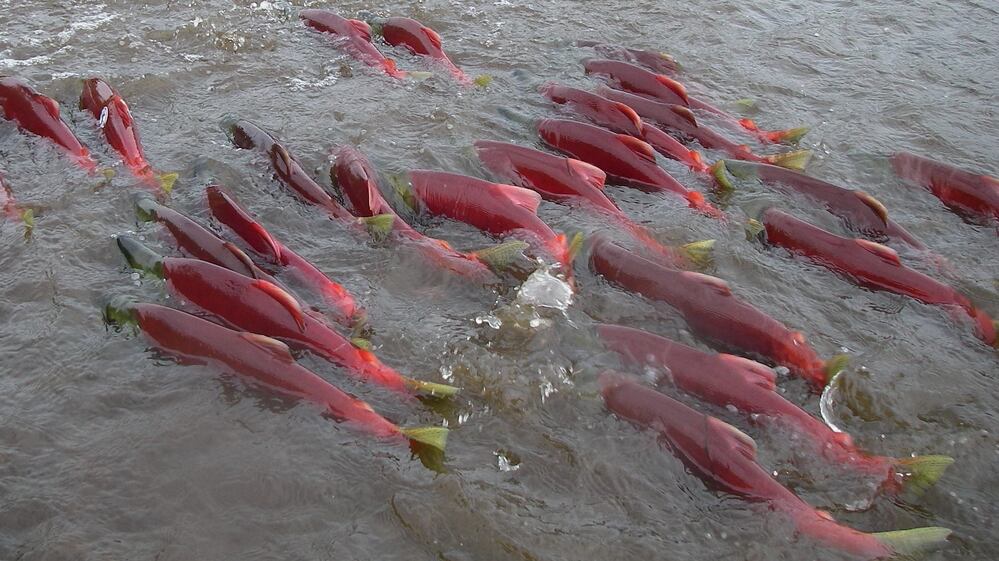
Bright red sockeye salmon swim up the Fraser River to the stream where they were hatched.
Current Biology, Putman et al.Before they end up filleted and sautéed on your dinner plate, salmon lead some pretty extraordinary, globe-trotting lives.
After hatching in a freshwater stream, young salmon make a break for the ocean, where they hang out for years, covering thousands of miles before deciding its time to settle down and lay eggs in their natal stream.
So how do these fish find their way back to their home river?
According to one theory, it's all about magnetism. When salmon are young, the theory goes, they imprint on the pattern of the Earth's magnetic field at the mouth of their native river. Years later, when the salmon head back home to spawn, they home in on that pattern. In a study published Thursday in Current Biology, the scientists behind that theory now say they have evidence that's exactly how the fish are navigating.
Magnetic detection "is one part of their toolkit for being really efficient navigators," says the study's lead author, Nathan Putman, a postdoctoral researcher at Oregon State University in Corvallis. The fish also use their sense of smell to help them locate the exact stream of their birth.
The finding could be helpful for fishery managers who'd like to predict where their fish will be and how their populations might change due to climate change and fishing pressures, Putman says.
Around the world, many salmon stocks are on the decline, and scientists would like to explain odd events, like why millions of wild sockeye salmon didn't return to Canada's Fraser River in 2009. It's possible a glitch in the salmon's navigational abilities played a role.
An even bigger concern is whether being raised in hatcheries somehow alters salmon's "internal GPS." Spawned in tanks, these salmon are released into streams and rivers and account for a large amount of the "wild" salmon that swim in the ocean and end up on your dinner plate.
Putnam worries that something about their hatchery upbringing could throw off how these salmon perceive magnetic fields. Because the Earth's magnetic field is relatively weak and can be overpowered by man-made objects, it's possible that something as simple as the iron reinforcements in the fish tanks, or nearby electrical cables, could throw off the salmon's magnetic imprinting.
"Then they might not be very good at navigating, and that could cause problems," he says.
If salmon born in hatcheries get lost on the way back home, they could end up in the wrong stream and interbreed with wild salmon populations. That's a problem, because studies suggest that hatchery-raised salmon aren't nearly as good at surviving outside captivity as their wild counterparts — and when they mate, the wild stock ends up genetically weaker.
View the original article here
Some 66 million years ago, about 75 percent of species on Earth disappeared. It wasn't just dinosaurs but most large mammals, fish, birds and plankton. Scientists have known this for a long time just from looking at the fossil record. If you dig deep enough, you find lots of dinosaur bones. And then a few layers up, they're gone.
But scientists couldn't figure out exactly what had caused this phenomenon. Of course, there were lots of theories.
"Some of them are pretty wacky," says J. David Archibald, an evolutionary biologist at San Diego State University who wrote the book Dinosaur Extinction and the End of an Era. "The really weird ones, of course, are that space hunters came and killed them all off, they died of constipation, mammals ate their eggs."
Then, in 1980, a new theory surfaced.
"It's the one that everybody hears about all the time because it's most dramatic," Archibald says.
Near what is now the town of Chicxulub in the Yucatan Peninsula, an asteroid more than 5 miles across slammed into the Earth. It caused tsunamis and earthquakes, and threw up a cloud of dust that smothered the world.
It sounds like a movie premise, but the Chicxulub impact left behind evidence. It threw up small blobs of black glass that were later found in Haiti. It dusted the world with iridium, an element that is rare on Earth but common in meterorites. It left a barely detectable imprint on the Yucatan Peninsula. Many scientists came to believe that the Chicxulub asteroid alone killed off the dinosaurs — and the public ate it up.
"We have this thing for big glitz and dramatic things," Archibald says. "Instantaneous is better."
But Princeton professor Gerta Keller wasn't convinced. She has her own theories about the mass extinction.
"Vulcanism has played a major role," Keller says.
In the hundreds of thousands of years before the Chicxulub impact, volcanoes in a region of India known as the Deccan Traps erupted repeatedly. They spewed sulfur and carbon dioxide, poisoning the atmosphere and destabilizing ecosystems. Keller says the dinosaurs were already on death's door by the time the asteroid hit.
And there is confusion about when that actually happened.
"If [the impact] is the cause, it had to be precisely at the time of the mass extinction," Keller says. "It can't be before and it can't be afterwards."
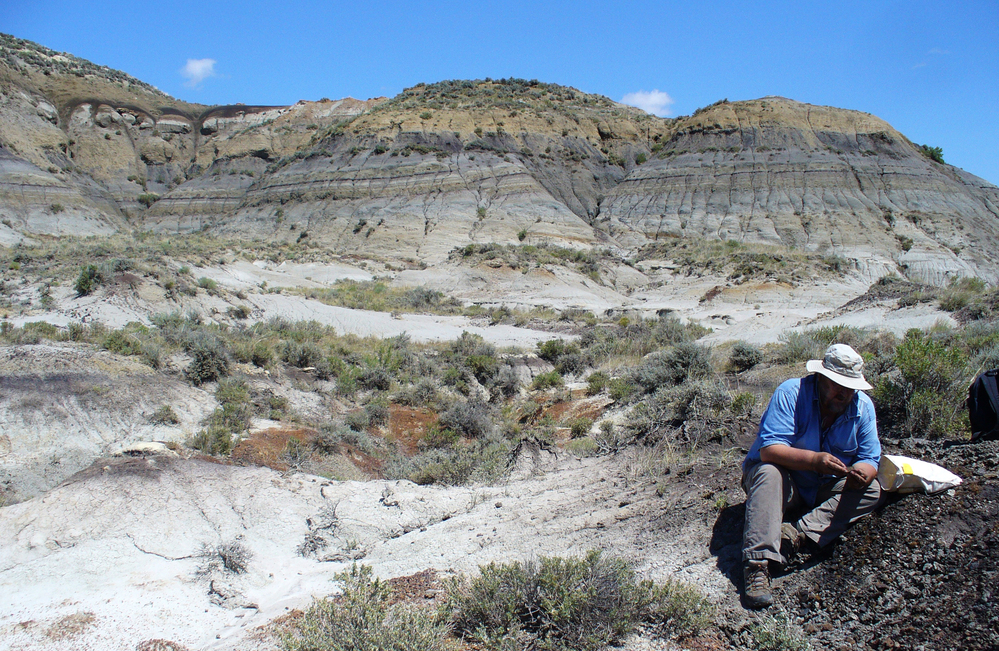
Geochronologist Paul Renne collects 66-million-year-old volcanic ash from a coal bed near Hell Creek, Mont.
Courtesy of Courtney SprainKeller's data suggest that the impact happened about 100,000 years before the mass extinction. Previous studies, on the other hand, put it 180,000 years after the dinosaurs died off.
Enter Paul Renne, a geologist from the University of California, Berkeley. To pin down the date, he headed out to the badlands of northeastern Montana.
"It's a region that has yielded a huge number of dinosaur fossils over the years," Renne says. "It's very famous for that."
Renne collected samples of ash that were deposited at the time of the mass extinction just above that treasure trove of fossils. He also obtained some of the glass blobs left by the Chicxulub impact. Measuring the rate of decay of radioactive potassium from these two samples, Renne was able to estimate the age of the impact and the age of the extinction.
"And lo and behold they are exactly the same," Renne says. "The impact clearly occurred right at the extinction level."
His results are published in the journal Science. They reinforce an idea that many scientists have held for years: The Chicxulub asteroid was the straw that broke the dinosaurs' back.
Gerta Keller thinks Renne's method was admirably precise, but she doesn't agree with some of his conclusions. She says his data are contradicted by other samples from Texas where a similar age date shows the Chicxulub impact predates the KT boundary — the point in time between the Cretaceous and Tertiary periods when the dinosaurs are believed to have gone extinct.
Still, there is one thing that Keller and Renne agree on: The asteroid isn't the whole story.
"There were significant extinctions and ecological perturbations going on a million or 2 million years before the impact, so we think that something else was already happening," Renne says. "What caused those things? There is an outstanding candidate — the early eruptions of the Deccan Traps."
The next step will be to find the age of these eruptions.
"We need to be able to place that set of eruptions into a time framework," Renne says.
Then they can better piece together what happened to the dinosaurs — and the rest of the species that went extinct. Renne and Keller will join Archibald and dozens of their colleagues at the Natural History Museum in London at the end of March to talk over their ideas.
"I'm looking forward to rather spirited discussions," Keller says.
View the original article here
In 2009, a team of researchers from the British Antarctic Survey were studying satellite images of the Antarctic when they noticed something interesting: trails of penguin poop. That showed signs of a huge emperor penguin colony.
The existence of the colony was unconfirmed until a team of researchers from the International Polar Foundation visited in December 2012.
Alain Hubert, founder of the International Polar Foundation, was one of three researchers from the foundation's Princess Elisabeth Antarctica polar research station to visit the 9,000-strong colony of penguins on Antarctica's Princess Ragnhild Coast.
"When you arrive, they just come to see you, to watch you, to turn around you," he tells NPR's Neal Conan. "The penguins — and especially the emperors — they are so human. They're so cute."
Since the penguins had never encountered humans, Hubert says they weren't scared, just curious.
Hubert and his team live at the research station during the Antarctic summer and are focused on studying climate change, not penguins. After they encountered a number of emperor penguins, they were convinced that a colony must be close by. They decided to make the treacherous 30-mile trip east to the sea ice.
"First of all, you have to imagine you're in the middle of nowhere — without any visibility, with complete whiteout after 24 hours driving on the ice — you go down to the sea."
After navigating their way to the sea, they searched for hours and found more penguins than they had ever imagined. Hubert says that seeing so many animals huddled together was like being on another planet.
"I spent more than five years of my life in the polar regions, but that was the kind of moment that I wouldn't have expect[ed] to be able to ... just enjoy," Hubert says. "It's a privilege."
If there was enough penguin poop to see from space, it seems like there would be quite a stench on the ground. Hubert says it wasn't a problem.
"It's too cold, really, to smell it, you know?" Hubert says. "I spoke to some scientists ... and they told me if it was a bit warmer, it's really smelly."
View the original article here

 Bright red sockeye salmon swim up the Fraser River to the stream where they were hatched.Current Biology, Putman et al.
  Geochronologist Paul Renne collects 66-million-year-old volcanic ash from a coal bed near Hell Creek, Mont.Courtesy of Courtney Sprain